Why Does PC Cooling Matter So Much?
Modern flagship processors routinely push boost clocks between 5.4 GHz and 5.8 GHz, concentrating upward of 250 watts of heat into a die area smaller than 300 square millimeters. This thermal density forces builders to think carefully about heat removal from the start.
Thermal throttling kicks in when the integrated heat spreader gets too hot. Performance drops as the CPU pulls back its clocks to stay safe. Gaming frame rates suffer and rendering jobs stretch longer than they should.
Heat moves from the die through the IHS and into whatever sits on top. The goal is simple: pull that energy away fast enough to keep temperatures under control during long sessions.
How Do Traditional Air Coolers Work?
Standard dual-tower air coolers utilize six to eight 6mm copper heat pipes to draw thermal energy away from the baseplate. Those pipes carry heat to stacks of aluminum fins where it can dissipate.
High-performance 120mm static pressure fans typically operate between 1,500 and 2,000 RPM to force ambient air through dense fin arrays, though this often requires a minimum RAM clearance of roughly 42mm to 45mm. The fan becomes the single moving part in the whole assembly.
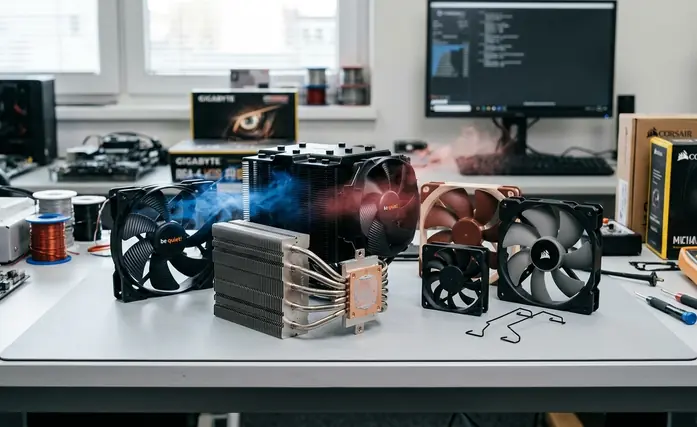
That single moving part is also the main reason these coolers last so long. Replace the fan and the cooler keeps working.
What Makes AIO Liquid Coolers Different?
AIO cold plates feature micro-skived copper fins spaced fractions of a millimeter apart, maximizing the surface area in contact with the propylene glycol and distilled water mixture. The pump pushes that mixture through permeation-resistant tubing to a radiator.
Liquid absorbs sudden heat spikes more evenly than solid metal alone. This lets the system handle brief power excursions without immediate temperature spikes at the die.
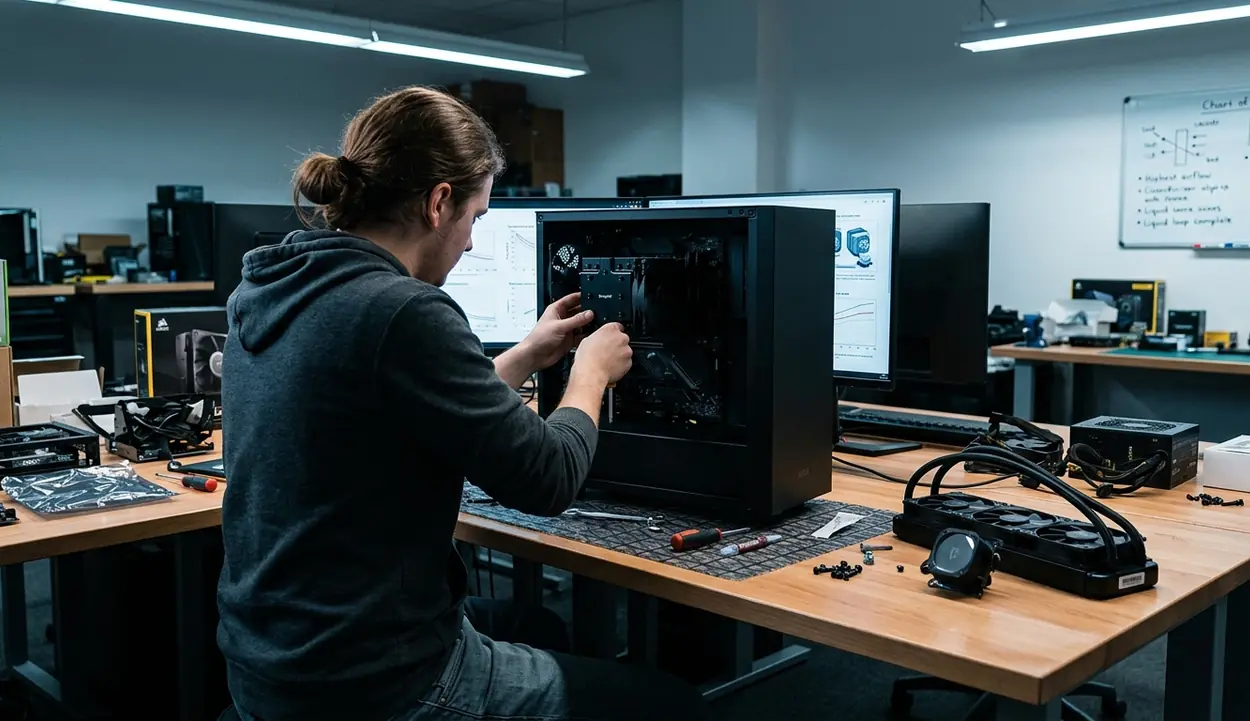
Standard AIO radiators measure between 27mm and 30mm in thickness, requiring specific case mounting brackets to accommodate the combined 52mm to 55mm depth when fans are attached. The radiator can sit at the front or top of the case, freeing space around the CPU socket itself.
What Are the Real-World Limitations and Trade-offs?
AIO pumps generate a constant mechanical hum typically measuring between 32 dBA and 36 dBA in our testing, whereas air cooler fans can drop below 20 dBA during idle loads. That steady pump noise becomes noticeable in quiet rooms.
Permeation through FEP or EPDM tubing causes a gradual loss of liquid volume over a 4 to 6-year operational lifespan, eventually degrading thermal transfer efficiency. Air coolers avoid this issue entirely because they have no liquid to lose.
Important: Investing in a 360mm liquid cooler yields severe diminishing returns on mid-range processors with a base TDP below 65 watts, where standard ambient case airflow is more than sufficient to prevent thermal throttling.
Which Cooling Solution Should You Install?
Processors drawing over 150 watts under sustained load generally require a 280mm or 360mm radiator to maintain peak boost frequencies over a 2 to 3-hour gaming session. Flagship chips benefit most from the extra surface area.
Dual-tower air coolers weighing upward of 1,200 grams provide a zero-maintenance alternative for builders willing to reinforce their motherboard sockets and sacrifice vertical case clearance. Check radiator mounting points and front-intake clearance before buying either option.
Builders chasing peak clocks and clean aesthetics lean toward AIO units. Those who want set-it-and-forget-it reliability stay with air. Match the cooler to the CPU tier and the case you already own.
Check official documentation on liquid versus air cooling for socket-specific clearance diagrams before finalizing any build.